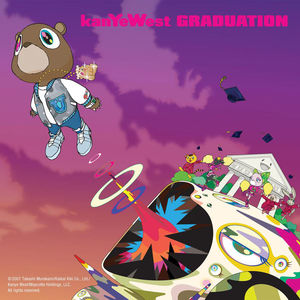
Graduation marked a deliberate pivot toward stadium-sized electronic music, its Takashi Murakami cover art signaling a pop-art sensibility. The album's release was framed as a chart battle against 50 Cent's Curtis, which Kanye won decisively with 957,000 first-week sales. Sonically it introduced European synth influences and arena anthems into his catalog, setting the stage for future experimentation.
Deep Dive
Background
Graduation was conceived as a deliberate pivot from intimate soul toward arena-sized electronic music, reflecting Kanye's ambition to perform at the scale of stadium rock rather than hip-hop's traditional club and theater circuit. Takashi Murakami's cover art — a bear ascending through psychedelic clouds — signaled the album's pop-art aspirations and its desire to exist in a broader cultural conversation. The release was orchestrated as a commercial event: Kanye and 50 Cent agreed to release on the same day, creating a much-publicized chart competition that Kanye won with 957,000 first-week sales to 50's 691,000. The victory was significant not just commercially but symbolically, marking a shift in hip-hop's center of gravity.
Themes
Graduation is an album about triumph and its complications — the moment you get what you worked for and discover it comes with new forms of loneliness. 'Can't Tell Me Nothing' and 'Champion' sit alongside more reflective tracks about identity, belonging, and the disorientation of rapid ascent.
Production
The album drew heavily from European electronic music, sampling Daft Punk, Can, and Michael Jackson while incorporating synthesizers and stadium reverb into a sound that felt genuinely new for hip-hop. The beats are built for scale — wide dynamics, huge drops, melodies designed to land in arenas rather than headphones.
Legacy
Graduation shifted the vocabulary of hip-hop production toward electronic and synth influences that became dominant in the decade that followed, and its commercial triumph helped end the era of traditional hip-hop dominance by demonstrating that the audience for cerebral rap could dwarf that for the genre's then-prevailing street narratives.
Best For
For moments of genuine victory — a long drive, a late-night run, the feeling that something you worked for has finally arrived.
Fun Fact
The 'Stronger' sample from Daft Punk's 'Harder, Better, Faster, Stronger' was initially denied by the French duo, and a personal phone call between Kanye and the band was reportedly necessary to secure clearance.
Tracklist — 13 songs
Producers — 1
Sample Map — 6 sources
Someone Saved My Life Tonight
Elton John · 1975 · Rock/Pop
Kid Charlemagne
Steely Dan · 1976 · Soft Rock/Jazz
Harder, Better, Faster, Stronger
Daft Punk · 2001 · Electronic/House
Sing Swan Song
Can · 1972 · Krautrock
P.Y.T. (Pretty Young Thing)
Michael Jackson · 1982 · Pop/R&B
Find a Way
Dwele · 2003 · R&B/Soul
Era — Stadium Status (2007–2008)
The stadium era charts two dramatically different responses to megafame. Graduation embraced European electronic music and arena-pop production to create a triumphant, synth-driven sound built for open-air festivals. 808s & Heartbreak, released months after his mother's death and a broken engagement, stripped everything back to Auto-Tune and TR-808 percussion, creating the emotional template for a generation of subsequent artists from Drake to Post Malone. Together these albums represent the outer boundaries of what mainstream hip-hop could sound like.
Also in this era